

I spent a month carrying both the Outlander Packable Daypack and the Eddie Bauer Stowaway on the same trails, and the short answer is this: buy the Outlander if you want a pack that carries weight properly, and buy the Eddie Bauer only if you want the lightest possible thing to keep in a glovebox. I am 5'6" with a short torso, I hike the Boise foothills most weeknights, and I have a left knee I have to manage on long descents. That means I care less about ounces on paper and more about how a pack rides when it is actually full. The Outlander won that test by a wide margin.
Both packs stuff into their own pockets, both cost about the same, and both are sold as travel daypacks. But they are not the same pack. The Outlander has lightly padded shoulder straps, a sternum strap, and side pockets for a water bottle. The Eddie Bauer Stowaway is a sack with thin straps and no structure at all. On a two-hour walk with a liter of water, a jacket, and a sandwich, you feel the difference in the first ten minutes.
| Outlander Packable Daypack | Eddie Bauer Stowaway | |
|---|---|---|
| Price | About the same as the Stowaway, often a few dollars less | About the same, occasionally on sale for a few dollars less |
| Carrying comfort | Lightly padded straps and a sternum strap, carries a moderate load without digging in | No frame, thin straps, load sags and pulls on the shoulders |
| Packed size | Folds into its own pocket, about the size of a small melon | Folds into its own pocket, slightly smaller and lighter |
| Organization | Main compartment, front pocket, two side mesh pockets, internal sleeve | Main compartment and one small front pocket |
| Best for | Day hikes, travel days, carrying a real load on your back | Emergency backup, theme parks, carrying a light layer and a water bottle |
Where the Outlander Wins
The Outlander wins on the only thing that matters to me: how it feels when it is full. There is no frame, so how you pack it matters, but the slightly heavier fabric holds its shape better than the Stowaway's. The shoulder straps have some padding, and the sternum strap keeps them from sliding off my narrow shoulders. On a 6-mile loop in the Sawtooths with 2 liters of water, a puffy jacket, and a first aid kit, the Outlander stayed put and stayed comfortable the whole way.
I want to be specific about that 6-mile loop, because the difference showed up earlier than I expected. It was a Saturday in late September, about 58 degrees at the trailhead, and Mark and I started up the switchbacks at a little after eight. I had the Outlander loaded with two liters of water, a down jacket, a sandwich, a first aid kit, and my camera. By the time we hit the first ridgeline, the pack had not moved. The sternum strap sat at the right height, the jacket I had packed against my back kept the bottles from digging in, and the padded straps spread the weight across my shoulders instead of concentrating it in two thin lines. On the descent, with my left knee complaining the way it always does, I did not have to think about the pack at all. That is the whole test, really. A packable daypack should disappear once it is on your back, and the Outlander is the only one in this category that has ever done that for me.
It also wins on organization. The front pocket is big enough for a phone, keys, and a snack bar. The side pockets hold a short water bottle well enough, though a tall one can work loose when I bend over, which is still more than most packs in this category offer. The Eddie Bauer Stowaway has one small front pocket and nothing else. When I hike, I want my water bottle where I can reach it without taking the pack off. The Outlander is the only packable daypack I have tested that does that at all.
Because neither pack has a frame, the way you load them decides how they carry, and the Outlander rewards a little care more than the Stowaway does. I put the softest thing I am carrying, usually a puffy jacket, flat against my back first. Water goes in the side pockets or low in the middle, food and the first aid kit on top, and the phone and keys in the front pocket. Loaded that way, the Outlander holds a shape that sits close to my spine. Loaded the same way, the Stowaway still sagged toward the bottom within a mile, because the fabric is thinner and the straps are anchored closer together.
The side pockets deserve a little more detail, because they are the reason I kept reaching for the Outlander on ordinary weeknights. On a typical Tuesday in the Boise foothills, I carry a 500 ml bottle in the right mesh pocket and my phone in the left one. I can grab either without stopping, without unclipping the sternum strap, without asking Mark to hold my pack while I dig around. The Stowaway does not have that option. Its single front pocket is fine for a phone, but the water bottle has to go inside the main compartment, which means taking the pack off every time I want a drink. That does not sound like a big deal until you are three miles in and stopping every twenty minutes. The Outlander's pockets are not a luxury feature. They are the difference between a pack I use and a pack I tolerate.
The packable daypack that actually carries like a real pack
If you want a daypack that folds into its own pocket but still has padded straps, a sternum strap, and side water bottle pockets, the Outlander is the one I reach for every weekend.
Amazon Check Today's Price on Amazon →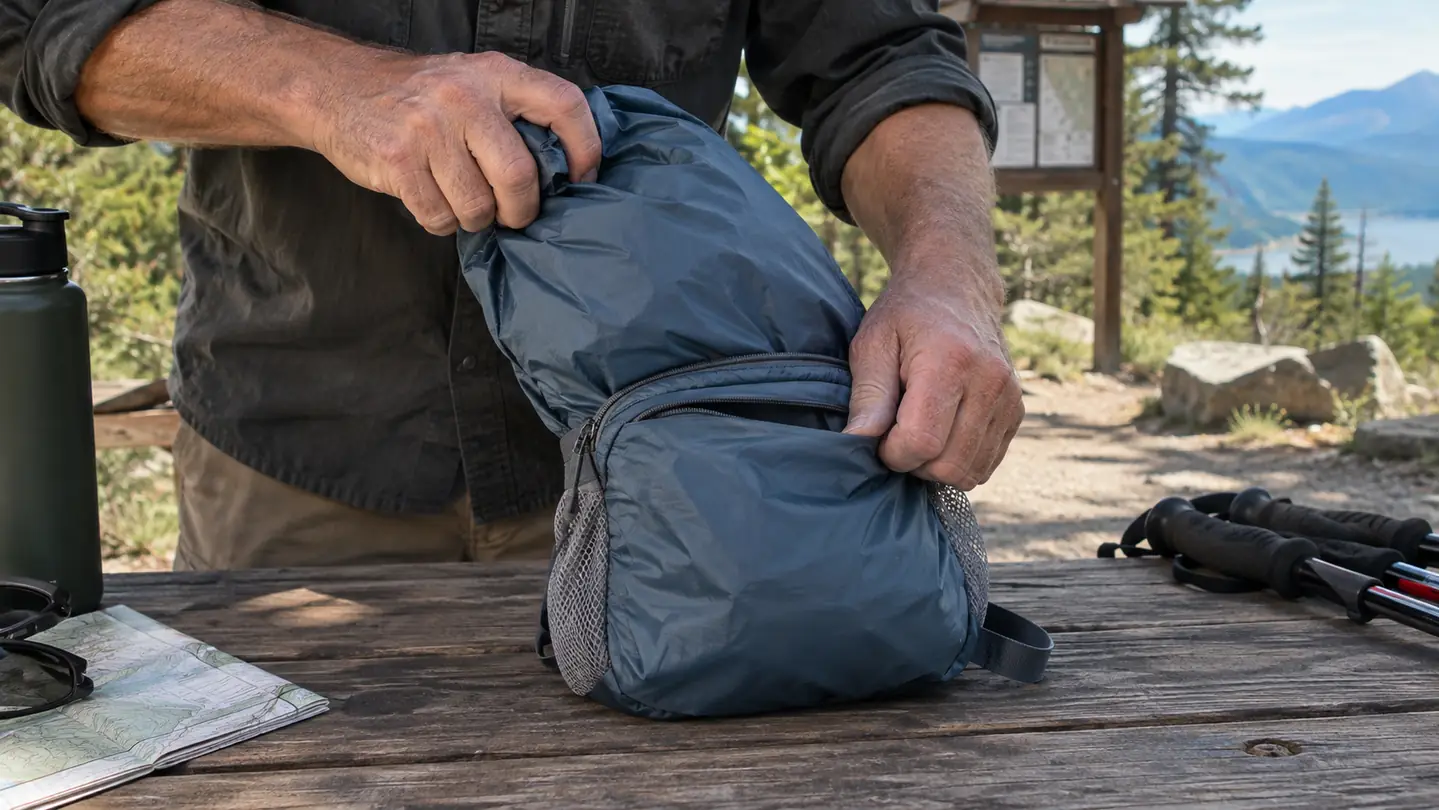
Where the Eddie Bauer Stowaway Wins
I am not going to pretend the Eddie Bauer Stowaway is a bad pack. It wins on packed size and weight, and those matter in one specific situation: when you want a pack that lives in a car or a carry-on and only comes out in an emergency. Stuffed into its pocket, the Stowaway is smaller and lighter than the Outlander. If you are the kind of person who wants a backup pack for a theme park day or a flight where you might pick up a souvenir, the Stowaway is the easier thing to justify carrying around.
I tested that exact scenario in October, on a long weekend trip where I flew out of Boise with only a carry-on. I put the Stowaway in the front pocket of my suitcase, where it took up almost no room, and I did not think about it again until I was standing in the airport gift shop holding a sweatshirt I did not need. I bought it anyway, stuffed it into the Stowaway, and carried the pack onto the plane. For that job, the Stowaway was perfect. It weighed nothing, it folded flat, and it did not make me look like I was wearing a turtle shell. The Outlander would have done the same job, but it would have taken up more space in my suitcase and been heavier on my shoulder. If your packable daypack is a just-in-case item, the Stowaway is the better tool.
It also wins on price when it goes on sale. The Stowaway regularly drops below the Outlander's typical price, and if you catch one of those deals, it is a perfectly fine pack for light duty. I used mine on a flat 3-mile walk along the Boise River and it was fine. The straps were thin and the pack sagged a little, but for a short, light walk, it did the job. I just would not want to carry it uphill with any real weight.
Let me be fair about that river walk, because it is the most charitable case for the Stowaway and I want the comparison to be honest. The trail along the Boise River is flat, shaded, and about 55 degrees on a good fall morning. I carried a liter of water, a light jacket, and my keys. The Stowaway handled it without complaint. The thin straps did not dig in because there was nothing heavy enough to make them dig in. The pack did not sag because I had not loaded it enough to sag. If every hike you take is a flat, short, lightly loaded walk, the Stowaway will serve you fine. The problem is that most of my hikes are not that. Most of my hikes start with a climb, and the moment the trail tilts up, the Stowaway's lack of structure becomes obvious. The pack starts to pull away from my back, the straps slide toward the edges of my shoulders, and I spend the whole climb adjusting something that should have been adjusted once.
The Stowaway also has one quiet advantage I did not expect: it is easier to stuff back into its pocket. After a long day, when the Outlander fought me a little on a hotel bed, the Stowaway went back in on the first try. If you will pack and unpack it every day of a trip, that matters more than it sounds. It is a small thing, but small things are what decide whether a backup pack actually comes along or gets left in the suitcase.
Who Should Buy Which
Buy the Outlander if you plan to actually hike with your packable daypack. If you are going to carry water, a jacket, and food for more than a mile or two, the padded straps and sternum strap are worth the extra ounces. I have carried the Outlander on 10-mile days in the Sawtooths and on travel days through airports, and it does both jobs without complaint. It is the pack I keep in my own rotation.
Buy the Eddie Bauer Stowaway if you want a true emergency pack. If it is going to sit in a car or a suitcase for months and only come out for a flat walk or a theme park, the smaller packed size and lighter weight win. Just know what you are getting: a sack with straps, not a hiking pack. For my money, the Outlander is the better buy for anyone who hikes regularly, and it is the one I recommend to friends.
One more thing worth saying, because it is the reason this comparison exists at all. I did not buy the Outlander expecting to love it. I bought it because I needed a pack that could live in my carry-on for a trip to the Sawtooths, and I assumed it would be a compromise. Instead, it became my default daypack. The Stowaway is now in the back of my closet, which is not a criticism of the Stowaway. It is a statement about what most of us actually do with a daypack. We do not need a pack that folds into nothing. We need a pack that carries a liter of water, a jacket, and a sandwich without making us think about it. That is the Outlander. If you hike regularly, even just on weekends, that is the one to buy.
My pick: the Outlander Packable Daypack
After a month of carrying both on the same trails, the Outlander is the one I reach for. It carries weight properly, holds a water bottle where I can reach it, and still folds into its own pocket.
Amazon Check Today's Price on Amazon →