
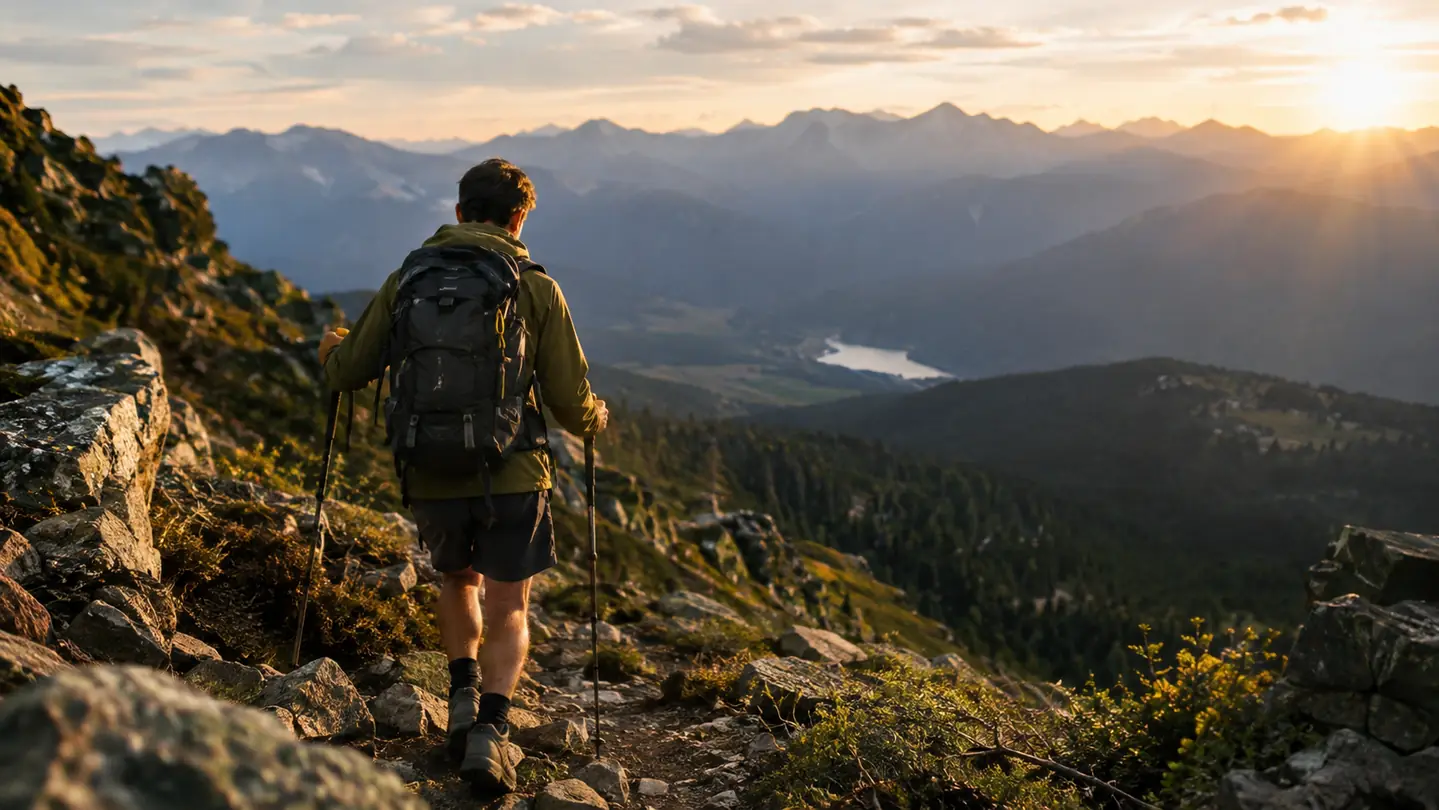
I am a physical therapy assistant, and I have hiked most weekends for about fifteen years. I am also 5'6" with a left knee that I have to manage on long descents. For a long time I treated poles as optional. Then one September, on a ridge above Redfish Lake in the Sawtooths, I took them off for a hundred yards of steep switchbacks and felt the difference with every step. I have not gone back since. The poles I reach for are made by Cascade Mountain Tech, and they have been on every hike since that day. If you are on the fence, here are the ten reasons trekking poles save your knees on steep descents, based on what I have actually felt on trails in the Boise foothills and the Sawtooths.
The poles I reach for every weekend
Cascade Mountain Tech makes a lightweight aluminum pole with an extended foam grip that I have used for years. It is the pair I grab for everything from a weeknight foothill loop to a long Sawtooth descent.
Amazon Check Today's Price on Amazon →They carry up to a quarter of your body weight on the way down
When you plant a pole downhill, your arms and shoulders take load that would otherwise land in your knees. Studies on walking poles consistently show a meaningful reduction in impact force through the lower body. I felt it most clearly on that September descent above Redfish Lake. With the poles, the load moved into my arms and shoulders. Without them, every step was a small slam into my left knee. On a steep pitch, that is the difference between a knee that is sore that night and a knee that is still fine the next morning.
They turn one big impact into two smaller ones
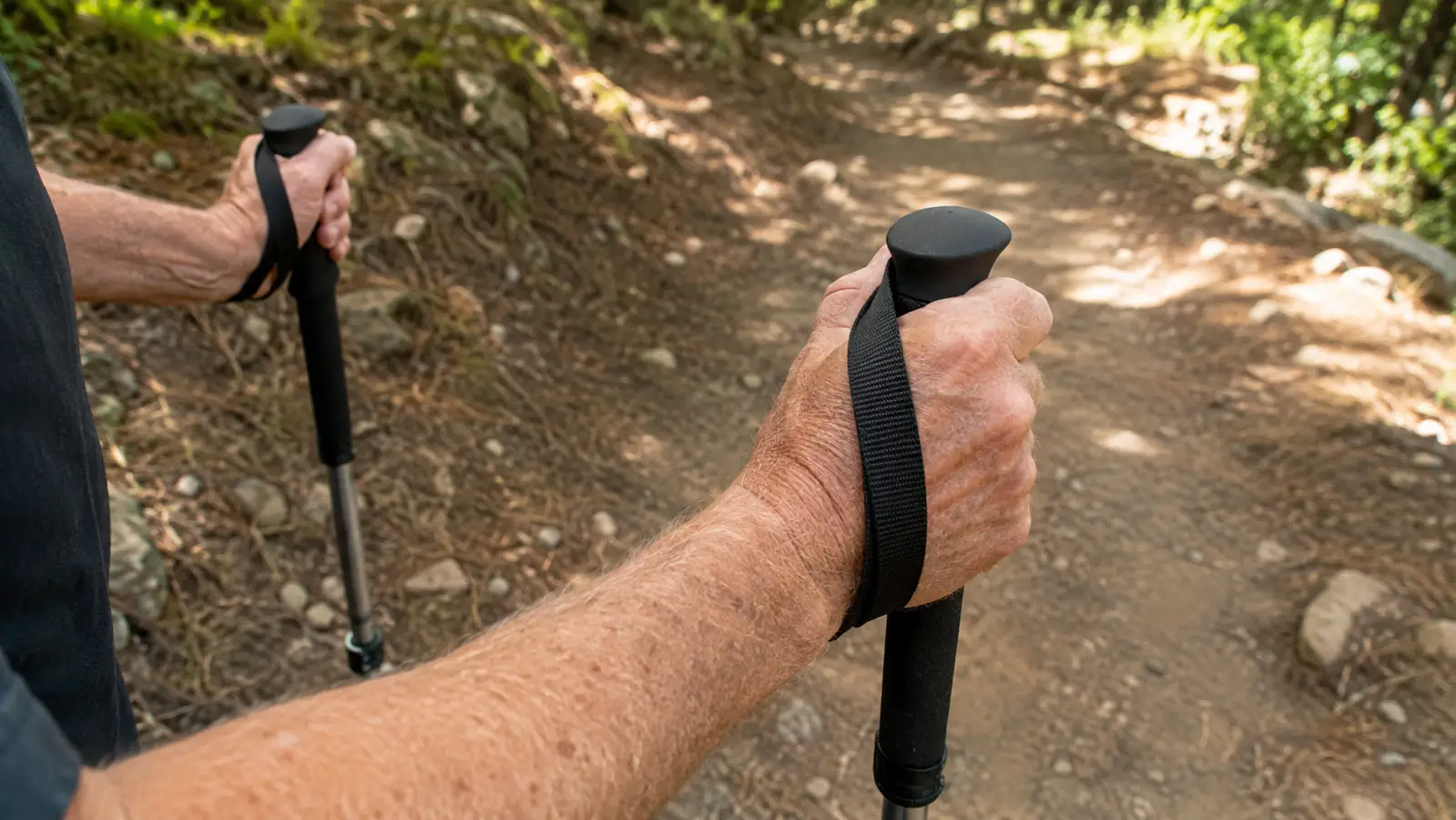
Every step downhill is a controlled fall. Without poles, your knee absorbs the whole landing in one hit. With poles, the load splits across four contact points, which spreads the force over a longer moment. I notice this most on the loose granite sections of the Sawtooth trails, where the footing shifts under every step. Smaller, smoother loads are easier on cartilage than fewer, sharper ones, and that is the whole argument for poles in one sentence.
They give you a brake you can modulate
On a loose gravel descent, poles let you scrub speed without skidding. You can plant them lightly to slow your rhythm or press harder when the trail gets steep. I use them like a hand brake on the switchbacks of the Alpine Trail, tapping the tips in ahead of each step so I never have to catch myself with my knees. That control means you are not catching yourself with your knees at the bottom of each stride.
They keep your weight over your feet instead of behind them
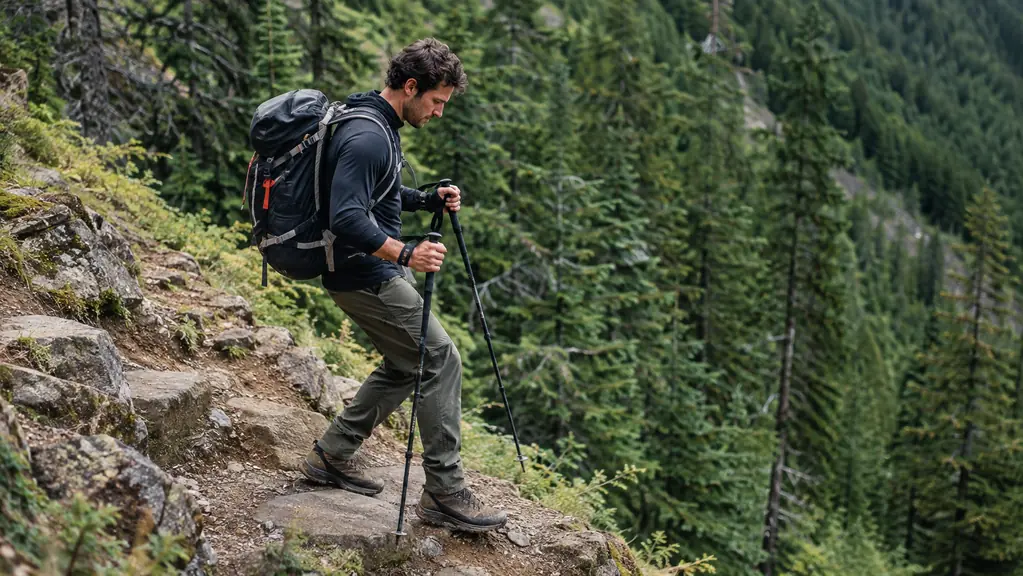
Tired hikers tend to lean back on descents, which jams the knees and strains the quads. Poles encourage a more upright stance with your weight stacked over your feet. I check my own posture constantly on the way down, and the poles are what keep me from settling back into that braking stance. On a steep descent I also shorten the poles by a few centimeters, which shifts my weight forward and keeps my heels from slamming into the ground. It is a small adjustment that makes a big difference over ten miles. Better alignment means less stress on the joint, and it also means you are less likely to slip.
They save your knees before you feel the pain
Knee cartilage has no nerve endings, so the pain you feel is already late to the party. I see this every week in my clinic. A patient comes in on a Monday after a big mountain weekend, no poles, and describes a dull ache that started on the descent and swelled overnight. The hikers who use poles consistently are the ones who do not show up with patellofemoral pain after a big weekend. It is the most predictable pattern I know.
They shorten your recovery time
When I use poles on a 12-mile day with 4,000 feet of descent, my legs feel like I did a normal hike. When I skip them, I spend the next day hobbling around the house. The last time I skipped them was a 9-mile loop on the east side of the Sawtooths. Dry trail, perfect weather, and I convinced myself I did not need the extra weight. I spent the next day on the couch with an ice pack on my left knee while Mark brought me coffee. The difference is not subtle, and it compounds over a multi-day trip.
They give you three points of contact on slick ground
On wet rock, mud, or the first icy patch of the season, two feet are not enough. A planted pole gives you a third point of contact and a chance to catch yourself before you go down. One early October morning I hit a patch of frost on a north-facing slope and my right foot slid six inches before the pole caught me. I have caught myself more times than I can count on Sawtooth switchbacks.
They take the fear out of the descent
When your knees hurt, you tense up, and tension makes you clumsy. Poles break that cycle. Knowing I have a brake and a third point of contact lets me relax, take longer steps, and move with better form. I notice it most at the end of a long day, when my left knee starts to ache and my stride shortens. With poles in hand, I can keep my rhythm and my balance all the way to the car. Relaxed descending is safer descending.
They protect your knees so you can hike tomorrow
The real cost of a knee injury is not the day it happens. It is the six weeks of no hiking while it heals. I have seen strong hikers lose an entire season to an overuse injury that poles could have prevented. A pair of poles is cheap insurance for the hobby you actually want to keep. I keep a pair in the back of my Subaru Outback year round, which is the real test of whether I will actually use them. If they are in the car, they go on the trail. If they were at home, I would talk myself out of carrying them.
They are the easiest knee fix that actually works
I have tried better shoes, orthotics, stretches, and strength work. All of them help. But none of them changes the load on your knees as directly as a pair of poles. Cascade Mountain Tech's aluminum poles are light enough that I forget I am carrying them, the extended foam grip lets me choke up on steep switchbacks without the collar digging into my palm, and they lock down to a size that straps neatly onto my pack. I have had the same pair for years and they have taken a beating on rocky descents. That is why they are the pair I keep grabbing.
What I'd Skip
I would skip poles with hard plastic grips if you hike for more than an hour. My hands sweat, and the hard grips get slick. I would also skip poles that do not have adjustable length, because the right length changes with the terrain. The one thing I would not skip is a pair with cork or foam grips. They cost a little more, but they last for years and they feel better on a hot afternoon. And if you only hike flat canal paths, you probably do not need poles at all. Save the weight and the money.
I have caught myself more times than I can count on Sawtooth switchbacks.
Give your knees a break on the next descent
Cascade Mountain Tech's trekking poles are the pair I have used for years, and they are still the ones I reach for first. You can check today's price on Amazon and decide for yourself.
Amazon Check Today's Price on Amazon →