

I will start with the part that usually gets left out of trekking pole reviews: the locking mechanism. Cascade Mountain Tech trekking poles use twist locks, and twist locks are the reason some hikers love these poles and other hikers return them after one trip. I have used this pair for a full season, roughly 400 trail miles between the Boise foothills and the Sawtooths, and I have a clear opinion now. The poles are genuinely good for the money. They are also not the right pole for everyone, and pretending otherwise does nobody any favors.
I am Nora, and I test gear the slow way. I am a physical therapy assistant, so I notice things like how much shock a grip absorbs and how a locked wrist angle changes over six miles. I am 5'6" with a left knee that needs help on long descents, and I hike most weekends with my husband Mark. These poles have been on weeknight foothill loops, on a 14-mile Sawtooth day hike, and on a flight to a trip, packed in a small checked duffel, where they were the difference between a good time and a rough one.
The Quick Verdict
A solid, lightweight, inexpensive pole that does the job for most hikers. The twist locks need a firm hand and occasional re-tightening, and the stock baskets are weak, but the grip and the weight are hard to beat at this price.
Amazon Check Today's Price →The poles I reach for every single hike
After a full season of testing, these are the poles that stay in my Subaru. Light enough to forget, comfortable enough for a 14-mile day, and cheap enough that I do not panic when they get scratched.
Amazon Check Today's Price on Amazon →How I've Used Them
I bought this pair in early spring and used them through summer and into fall. That included a 14-mile day in the Sawtooths with about 4,200 feet of elevation gain, a handful of 8 to 10 mile weekend hikes, and countless shorter evenings in the foothills when my knee was telling me to take the descent seriously. I also flew with them once, which matters to me because I usually travel light and had to decide whether poles were worth checking a bag.
The poles collapse into three sections, and with the top section pulled off they pack down short enough to lie flat across the bottom of a small checked duffel. That is a detail most reviews skip. They are light for aluminum poles, and on the trail they feel it.
I used them with the standard carbide tips on dirt, rock, and a little bit of snow. I did not use the included rubber tips much, because the trails I hike are mostly dry. I did use the baskets, and that is where my first honest complaint shows up.
Setup took me about ten minutes the first time, and most of that was me being careful. I set each pole so my elbow sat at roughly a right angle with the tip on the floor, then marked that spot on the lower section with a thin strip of tape so I could find it again in the dark at a trailhead. On the trail I shorten them by about two inches for long climbs and lengthen them by about the same for descents. The Cascade Mountain Tech poles have printed length markings, but they are small and they wore faint by midsummer, which is why the tape stayed on all season.
What Nobody Tells You About the Twist Locks
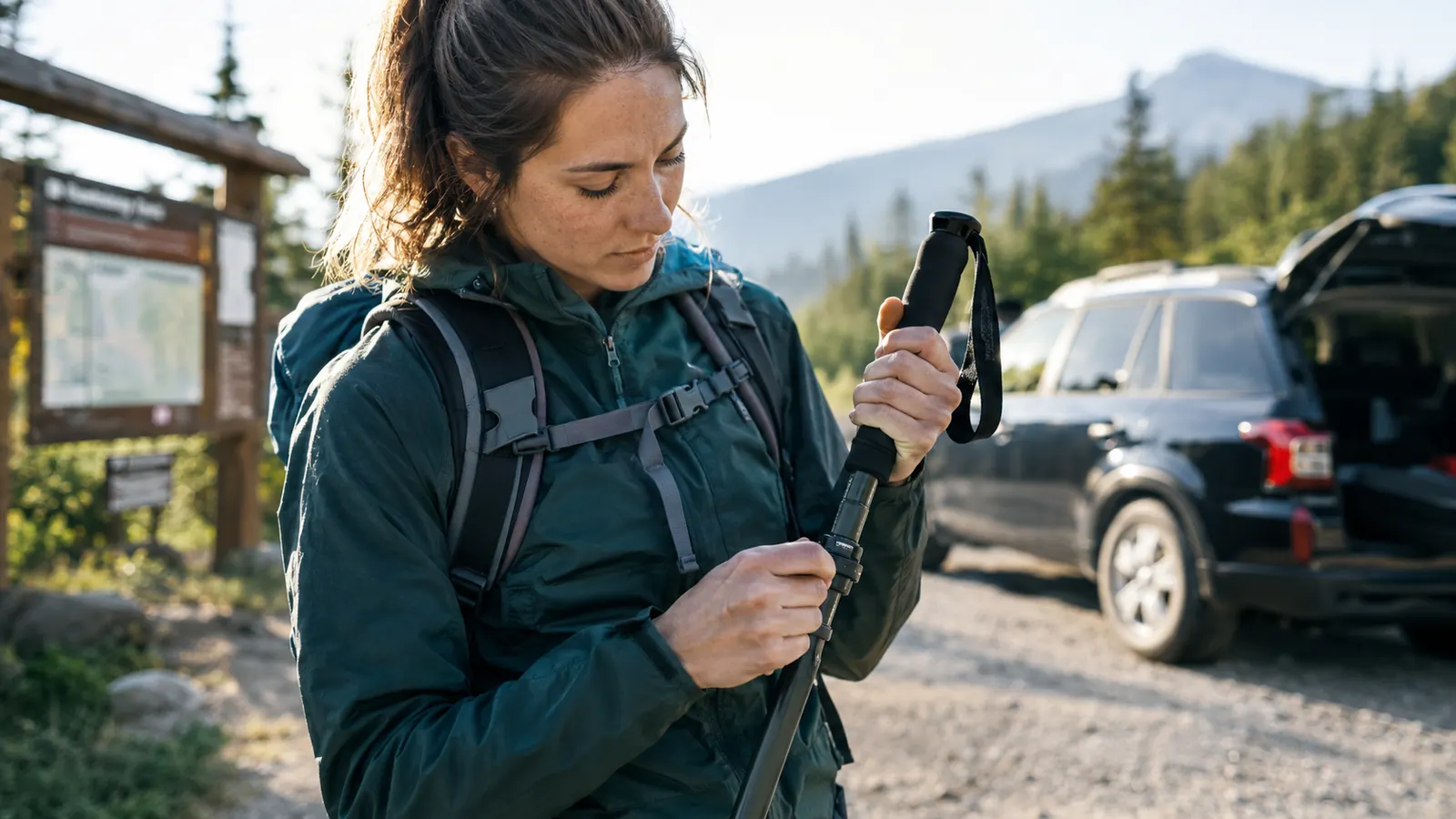
The biggest thing nobody tells you about Cascade Mountain Tech trekking poles is that the twist locks require a real amount of force to tighten properly. The first time I adjusted them, I thought I had broken something. You have to twist each section until it stops, then give it an extra firm turn. If you do not, the pole slowly collapses under your weight on the first steep section, which is exactly what happened to me on a warm-up hike.
Once I learned the trick, the locks held fine for the rest of the season. But I re-tightened them a few times during long days, especially after the poles got wet or dusty. That is normal for twist locks, and it is the tradeoff you accept for a pole that costs a fraction of what a carbon fiber pair costs.
Here is the routine that finally worked for me. Pull the section out past the length you want, push it back to the mark, then twist hard, harder than feels polite, until the expander inside bites. Then put your weight on the pole at the trailhead, before you need it. If it slips at all, back it off and do it again. I also learned to pull the sections apart and let them dry after a wet day, because grit and moisture inside the shaft are what made one lock creep on me in June. A thirty second wipe at the car fixed that, and it never crept again.
The other thing nobody tells you: the stock baskets are not great. They are small, and they pop off if you catch them on brush or rock. I lost one on a short off-trail scramble in the Sawtooths and had to finish the day with a bare shaft. Replacement baskets are cheap and easy to find, and I would buy a set of larger ones if you plan to hike in soft ground or snow. This is a small fix, but it is a real one.
Replacement baskets are cheap and easy to find, and I would budget for a set from day one. Wider snow-style baskets also help in loose sand and soft spring mud, where the stock ones sink. If you hike mostly on packed dirt and rock you may never miss them, but if you lose one on a scramble the way I did, you will be glad you have a spare in the glovebox.
The twist locks held up for 400 miles once I learned to tighten them with real force. The stock baskets did not survive the season.
The Grip Is the Best Part
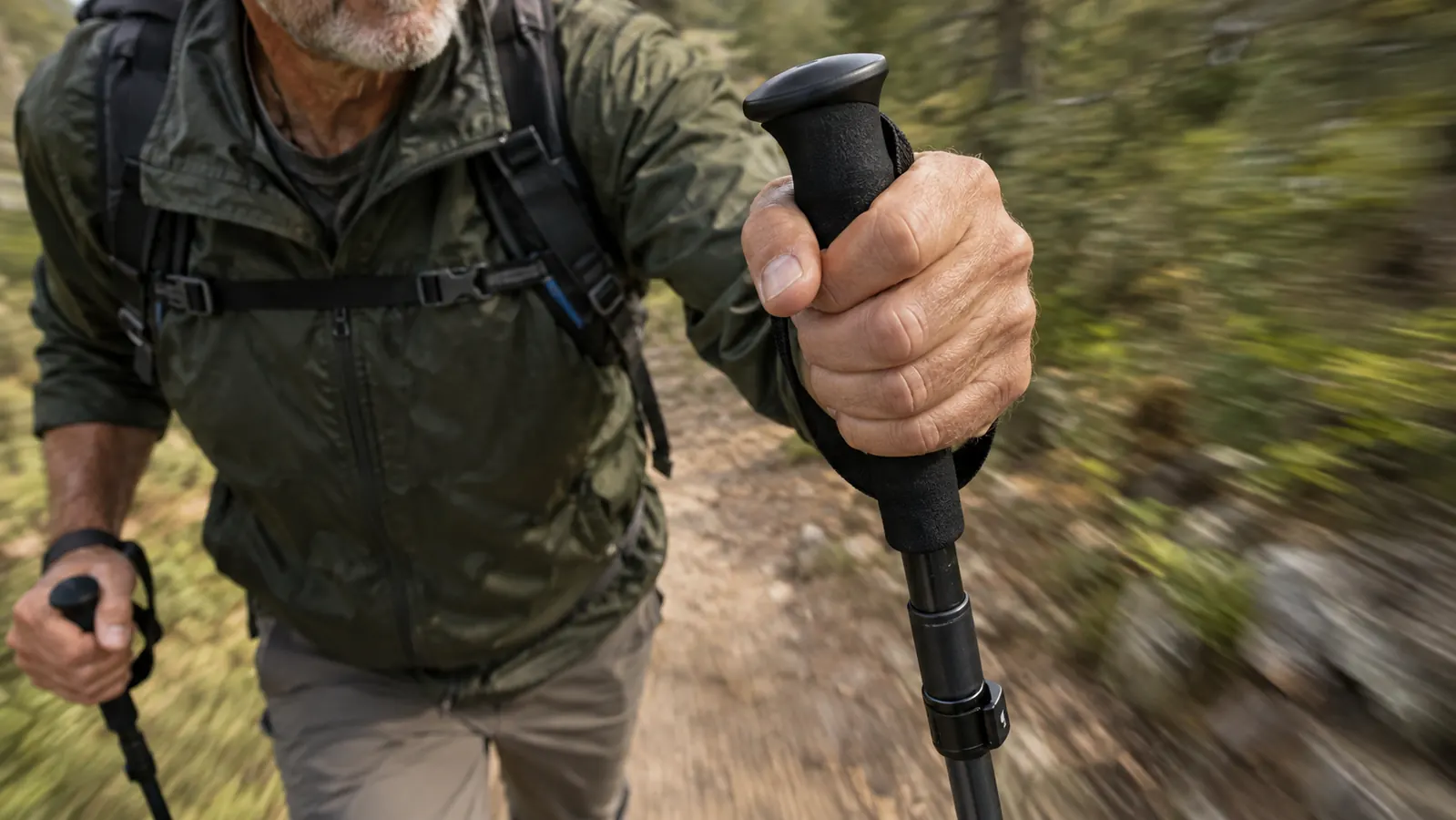
The extended foam grip is the reason I would pick these poles again. The grip runs well below the top of the handle, which means I can choke down on it for steep climbs without my hand sliding onto the bare shaft. On a long ascent, that extra grip area is the difference between comfortable and annoying.
The foam is firm but not hard, and it does not get slippery when my hands sweat. I have used cork grips on other poles, and cork is nice when it is dry and clammy when it is wet. The foam on these poles is more consistent. It also does not absorb water the way cork can, which matters on a rainy day in the foothills.
The wrist straps are simple and they work. They are not the padded, angled straps you get on expensive poles, but I never felt like I needed more. I keep them loose on the flats and tighten them on descents so my weight transfers through the strap instead of my grip. That is a technique thing, not a gear thing, but the strap has to be good enough to make it work. These are.
One more grip detail that matters on steep ground. On a long climb I choke down and hold the foam a hand's width below the top, instead of stopping to shorten both poles every time the grade changes. On the Cascade poles the foam runs far enough down the shaft that my hand still lands on foam there and not on bare metal. On cold mornings that is the difference between comfortable fingers and numb ones, and on a hot afternoon the foam stays drier than plastic would. It is a small design choice, and I use it on almost every hike, mostly without thinking about it at all.
How They Perform on the Trail
On flat ground, these poles are nearly invisible. They are light enough that I do not notice them in my hands, and the swing weight is low. On climbs, the extended grip earns its keep. On descents, they do exactly what I need them to do: take pressure off my left knee. I noticed a real difference on a 2,000-foot descent in the Sawtooths, where my knee was sore but not angry afterward.
The aluminum shafts flex a little more than carbon fiber, but I do not consider that a flaw. The flex absorbs some shock, and for a hiker with a sensitive knee, that is a feature. The poles are not as stiff as a high-end carbon pair, and if you are a heavy hiker who puts a lot of force through your poles, you may feel the difference. At my size, I do not.
The carbide tips bite well on rock and dirt. On slickrock, they skitter a little, but that is true of every trekking pole I have used. The rubber tips are fine for pavement, though I mostly leave them at home because I am not walking on pavement much.
The descents are where these poles earn their place in my pack. My left knee is the reason I started using poles at all, and on the long drop off a Sawtooth ridge I plant both poles slightly ahead and let my arms take some of each step down. On a three-mile descent that adds up. I finish with a knee that is tired rather than angry, and I notice the difference the next morning more than I notice it on the trail. That is not a medical claim, just what I see on my own body after fifteen years of weekends. Poles also give me two extra points of contact on loose gravel, which is where I used to slip.
The Flying Test
I flew with these poles once, and the lesson was simple: they go in the checked bag. Trekking poles are generally not allowed through airport security in a carry-on, so I collapsed both, pulled the top sections off, wrapped the tips in an old sock and laid them along the bottom of a small duffel with my boots. They came out the other end without a scratch, and the short collapsed length meant I did not need a long ski-style bag to protect them.
If you fly to trailheads, that collapsed length is a real advantage. A pair of fixed-length poles would need a long tube or a much bigger bag, and even some three-section poles are noticeably longer when collapsed. Check your airline's current rules before you pack, but plan on checking them rather than carrying them on.
Pros and Cons
What I Liked
- Very light for aluminum poles, easy to carry all day
- Extended foam grip is comfortable and works well when wet
- Collapse short enough to lie flat in a small checked duffel
- Carbide tips bite well on dirt and rock
- Price is low enough that I do not worry about scratches
Where It Falls Short
- Twist locks need a firm hand and occasional re-tightening
- Stock baskets are small and pop off easily
- Aluminum shaft flexes more than carbon fiber
- No padded or angled wrist straps
Who This Is For
These poles are for the hiker who wants a light, comfortable, inexpensive pole and is willing to learn one small quirk. If you hike a few times a month, if you are starting out, if you want a pair that does not make you nervous on a rocky descent, these are a great fit. They are also a great fit for travelers who want poles that pack small.
I would also recommend them to anyone who is not sure they will like trekking poles at all. The price is low enough that trying them is not a big commitment, and the grip is good enough that you will actually use them. That is the test that matters.
Who Should Skip It
Skip these if you are a heavy hiker who puts a lot of force through your poles, or if you want the stiffest possible shaft. A carbon fiber pole will feel more solid under heavy load, and if you are doing long, technical routes every weekend, the extra money may be worth it to you.
Skip them if you hate fiddling with gear. The twist locks are not difficult, but they are not as simple as a flick-lock system. If you want to set your pole length once and never think about it again, a lever-lock pole might suit you better. And if you hike mostly in soft ground or snow, plan to buy better baskets right away, because the stock ones will not last.
Skip them, too, if you want one pole for winter backcountry use. The stock baskets are not made for deep snow, and aluminum gets cold in your hands fast if the foam does not reach where you are gripping. For three-season hiking on ordinary trails, though, the Cascade poles do the job without asking much from you.
The Bottom Line
Cascade Mountain Tech trekking poles are not perfect. The twist locks take a firm hand, the baskets are weak, and the aluminum shaft is not as stiff as carbon. But after 400 miles, I reach for them every time. They are light, comfortable, and they have saved my left knee on more descents than I can count.
If you want a pole that works, packs small, and does not cost a fortune, these are a smart buy. If you want the last word in stiffness or the simplest possible lock, look elsewhere. For everyone in between, this is the pair I would recommend to a friend, and I have.
Still the pair I grab first
After a full season and 400 miles, these are the poles I keep in the car. Light, comfortable, and easy to pack. See today's price on Amazon and decide for yourself.
Amazon Check Today's Price on Amazon →